
I recently attended a talk by David Brooks, whom I first knew as the conservative voice on The MacNeil/Lehrer NewsHour and more recently as a writer for The New York Times and The Atlantic. He was speaking at a local university, and I didn’t want to miss it.
Unsurprisingly, he had a lot to say. But one idea has stuck with me and keeps resurfacing in conversation: life as a series of rupture and repair. Things come together, then fall apart, over and over again. He cited Samuel P. Huntington, who argued that roughly every 60 years, the United States experiences a kind of moral convulsion, a “burn it all down” moment. Brooks pointed to the 1770s, the 1830s, the 1890s, the 1960s, and now, the 2020s.
(I’ll pause here while your head explodes like mine did upon hearing that.)
That’s the bad news. The good news, Brooks said, is what comes after. Out of these periods of upheaval, we rediscover something essential about ourselves that we are a people who long, who yearn, who rebuild with energy and purpose.
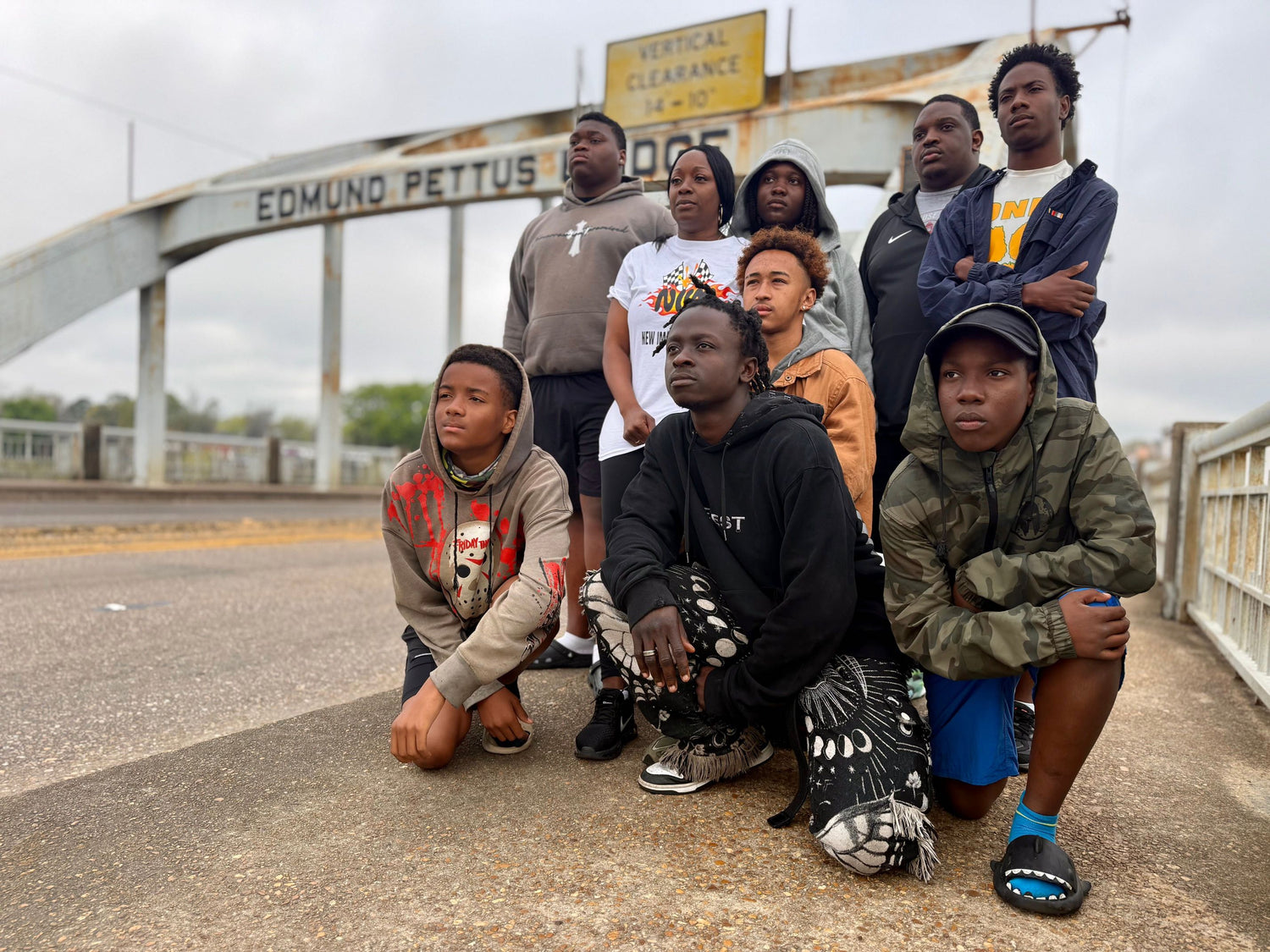
I saw that firsthand this March. I had the honor of rucking alongside members of The Give Team on their annual journey from Selma to Montgomery. The Give Team is the only endurance group made up of underserved youth and their mentors, and they are extraordinary.

Back in 2021, in the middle of our own national reckoning, I reached out to one of their leaders, Brad Mason, about donating proceeds from a 54-mile Selma-to-Montgomery rucking challenge. Our community would complete the distance over a month, in honor of those who marched it in 1965 for the Voting Rights Act.
Brad likes to tell the story that he said, “Sure, do the fundraiser twice,” with a wink and a grin. GORUCK Nation showed up, as we do.
But that was just the beginning. One of the athletes, Smit, suggested they should ruck the actual route themselves, following in the footsteps of John Lewis, Amelia Boynton Robinson, and the hundreds of others who marched in 1965. Ideas are only as powerful as they are contagious.
So Brad and Smit did it, 54 miles, to prove it could be done. The following year, more joined. This year, I made the pilgrimage to Selma to join 15 members of The Give Team and retrace that history.

There were months of preparation behind those 54 miles. Training through injuries, through loss, through the daily friction of life. One woman had recently undergone heart surgery. One young man had lost his father just months earlier. Others struggled to fit in training between school and work.
Brad has a line he repeats: “Your 5 a.m. voice is not the same as your 5 p.m. voice; but you always have something to give.”
We completed in 24 hours what the original marchers did over five days and four nights. We had better gear, better weather, and a support vehicle. They had dress shoes, cold rain, and the constant threat of violence, another Bloody Sunday. As the miles wore on, the pain moved through our feet, hamstrings, shoulders, then into our heads. Breaks came more often. Some rested in the support vehicle overnight but stayed close, rejoining when they could. Five of us rucked through the entire night. Smit kept track of the reactions we received along the way, (mostly) friendly honks, waves, and cheers.
As we approached Montgomery, the first light of morning brought that familiar surge of hope, the kind that only comes after the darkest stretch. We turned onto Rosa L. Parks Avenue and made our way toward the city center. Then it appeared: the final climb to the Alabama State Capitol.

We moved two by two up the hill, taking advantage of traffic blocked for another cycling and relay race finishing nearby. At the top, we crossed the other race’s finish line and were met with applause. People were stunned to learn we had come from Selma just the day before.
“I saw y’all yesterday!” one woman wearing bright sunglasses kept saying. “Y’all came all this way on foot?”
We celebrated, ate, and then collapsed into much-needed rest.
The next morning, we gathered at the David Hall farm, Campsite 1 from the 1965 march. David Hall, one of the few Black landowners in Alabama at the time, had offered the marchers a safe place to sleep. His descendants welcomed us into their home, fed us pancakes, and shared photographs.

We even spoke with Alice Thompson Moore, a woman who had attended all three marches back in the day. She described marching at 16 years old alongside her 14-year-old sister, cold, scared, but determined.
Our youngest rucker was 14. The room went quiet when the team realized those marchers weren’t much older than they are now.
Brooks says that after a moral reckoning, three things follow: a cultural shift, a civic renaissance, and finally, political change. He offered this advice to the audience: go on adventures, take risks, listen to your indignation, and find your people, your “magic circle.”

The Give Team’s journey from Selma to Montgomery checks every one of those boxes. But more than that, it offers something harder to articulate and more important to hold onto: in every era that feels like it’s coming apart, there are people quietly doing the work of putting it back together. Not all at once or perfectly. But step by step, mile by mile.
And sometimes, if you’re lucky, you get to walk alongside them and realize that the repair has already begun.


emily McCarthy
Co-founder & Chief Community Officer
GORUCK